BIM & Digital Delivery
From Concept to Digital Handover: How EDS Manages BIM from LOD 100 to LOD 500
A controlled BIM information-delivery process from early concept strategy to a verified, maintainable digital asset.
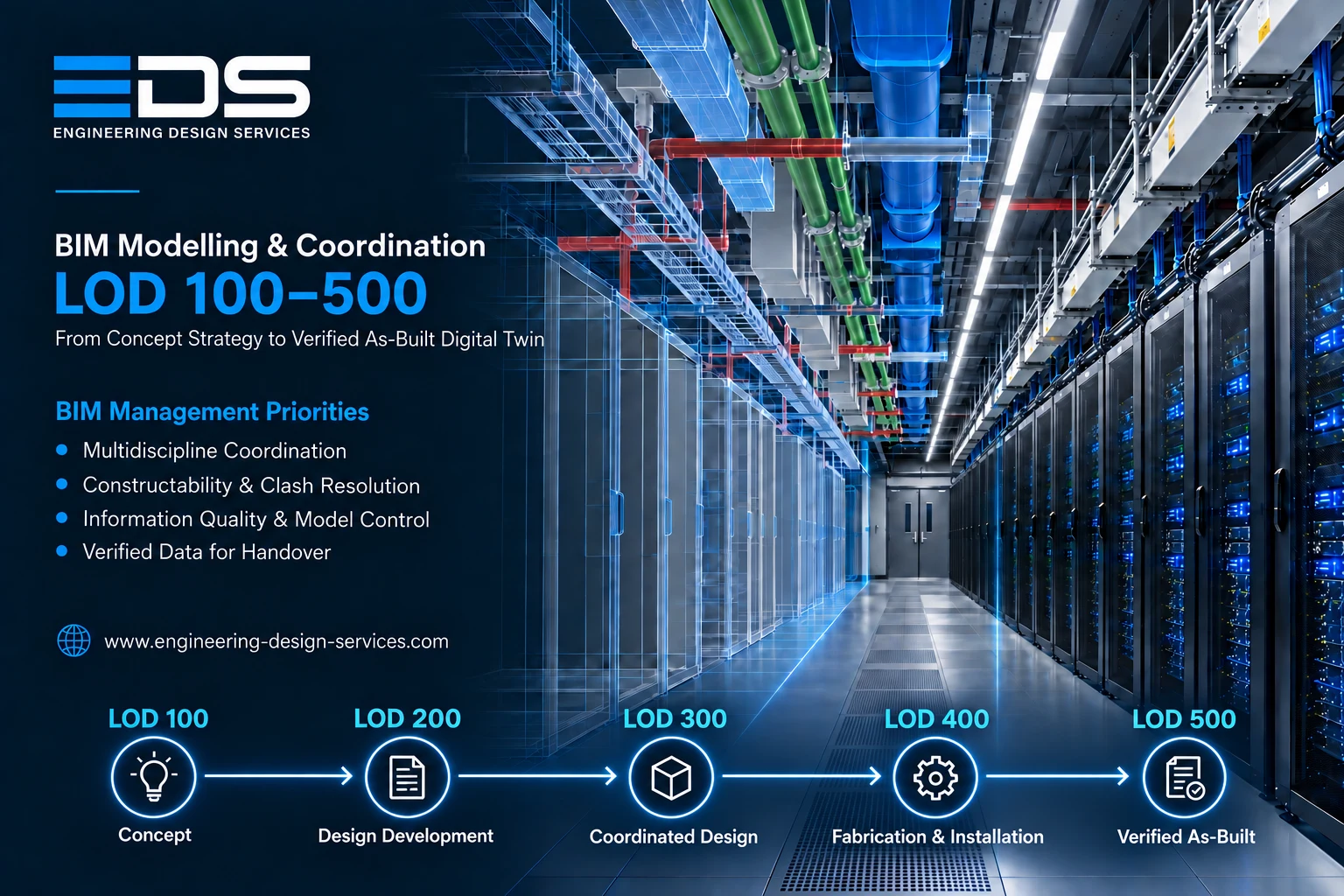
BIM as a Managed Information Process
Engineering Design Services (EDS) manages BIM in alignment with the Employer’s Information Requirements, BIM Execution Plan, and agreed responsibility matrix. Model standards, discipline inputs, information quality, and coordination issues are controlled through an approved Common Data Environment, creating a consistent and traceable source of project information across architectural, structural, electrical, mechanical, fire-protection, BMS, ICT, and security disciplines.
Model Development from LOD 100 to LOD 500
- LOD 100 Concept Strategy
Establishes the conceptual model, spatial requirements, system capacities, and primary engineering strategy.
- LOD 200 Design Development
Develops approximate systems, equipment zones, and principal routes for multidisciplinary coordination.
- LOD 300 Coordinated Design
Defines dimensions, locations, clearances, and interfaces for coordinated reviews and systematic clash detection.
- LOD 400 Fabrication and Installation
Coordinates constructible connections, builders’ work, supports, access zones, and installation interfaces.
- LOD 500 Verified Digital Handover
Verifies relevant geometry and asset information against site conditions and integrates operational records.
Controlled Coordination and Construction Delivery
At LOD 400, EDS works with contractors, manufacturers, and specialist vendors to develop constructible information, including equipment connections, builders’ work requirements, supports, access zones, and installation interfaces. Changes move through controlled coordination and approval workflows, protecting design intent, improving constructability, and reducing installation risk.
Verified Digital Handover
Following installation, the model progresses to LOD 500. Relevant geometry and asset information are verified against site conditions and integrated with commissioning records, operation manuals, and maintainable asset data. The result is more than a detailed model: it is a coordinated and reliable digital information asset supporting construction, commissioning, facility management, and future digital-twin applications.
EDS maintains information quality and engineering continuity throughout the BIM lifecycle—from concept decisions to a verified digital record ready for operation.
Share this article
Share on LinkedIn